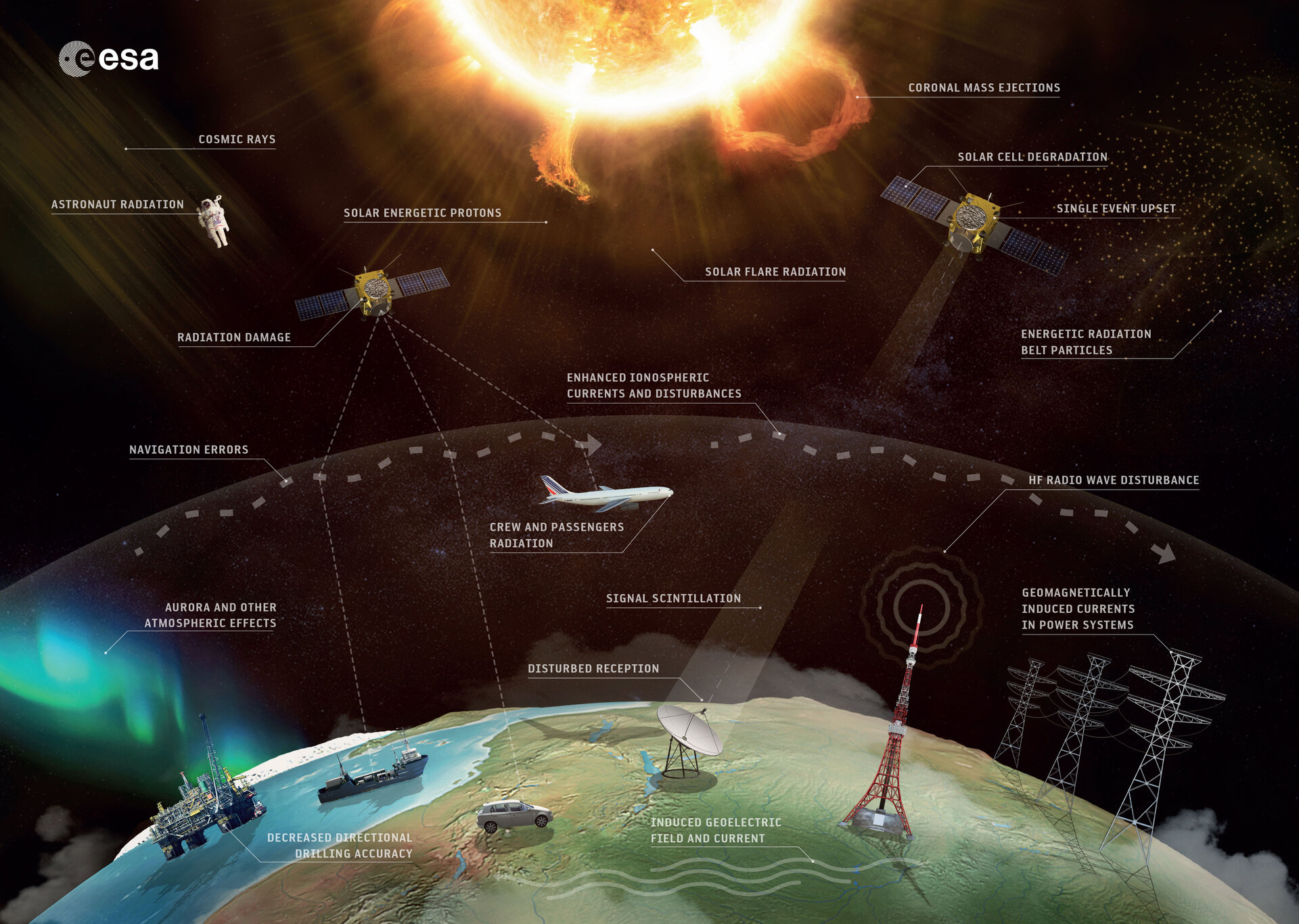
Protect Space Weather Demonstrator

Introducing the Protect Space Weather Demonstrator
1 – The Protect Accelerator
In line with the Council Resolution “Accelerating the Use of Space in Europe”, also known as the Matosinhos Manifesto, the ESA Director General established the Protection of Space Assets (Protect) Accelerator to contribute to safeguarding European assets from space debris and space weather interferences. This initiative is implemented by the ESA Directorate of Operations and leverages the capabilities developed within the Space Safety Programme (S2P).
Aligned with the Seville Resolution’s call to establish operational space weather services in Europe, ESA’s Strategy 2040 outlines this as a strategic priority. By engaging with key stakeholders, the Protect Accelerator seeks to raise awareness of the importance of reliable and accurate space weather now- and forecasts, ultimately enhancing the protection of both space assets and critical ground-based activities.
2 - Phase 1 of the Space Weather Demonstrator (Arctic Phase)
The Arctic Space Weather Demonstrator, launched in 2023, focused on testing the use of existing space weather services within a restricted geographical area during a period of increasing solar activity. This initiative was a joint Finnish-Norwegian contribution to the Protect Accelerator, with three key objectives:
- Collecting end-user feedback on ESA’s Space Weather Services.
- Improving understanding of space weather’s impact on key sectors.
- Raising awareness of the benefits of space weather services within new and existing user communities.
Published in 2024, the final report of the Arctic Phase highlighted space weather activity and resulting impacts in the region. It emphasised the need for comprehensive user engagement to shape relevant and impactful space weather services. Additionally, it highlighted the challenges of increasing awareness and accessibility of space weather services, the need for expanded service tailoring and integration into pre-existing systems, and the importance of improving forecasting reliability.
3 - Phase 2 of the Space Weather Demonstrator (Sectorial Phase)
Following requests from ESA Member States, the Protect Accelerator has launched the second phase of its Space Weather Demonstrator: the Sectorial Space Weather Demonstrator. This phase aims to enhance sector-specific engagement and broaden participation across Europe, focusing on three high-priority domains:
- Power system operation
- Spacecraft operation
- Communications & PNT (Positioning, Navigation, and Timing)
Launched on 24 January 2025, the Sectorial Space Weather Demonstrator includes 16 organisations from 15 states, acting as National Points of Contact (NPOCs).
The initiative will distribute and collect a survey via the NPOCs, targeting key space weather end-users within the three identified priority sectors. The objectives include:
- Collecting end-user feedback on ESA Space Weather Services.
- Improving understanding of space weather impacts on critical sectors.
- Raising awareness of space weather service benefits among both new and existing user communities.
Published in 2026, the second interim report on the questionnaire results shows that, among the end users consulted, uptake of space weather services remained limited, with 36% of respondents reporting current use, despite generally moderate self-assessed understanding of space weather risks (mean 3.53/5) and strong expressed demand for additional information on both risks and available services (79% for each).
Across domains, respondents prioritised service fundamentals—accuracy, clarity, accessibility and timeliness—yet satisfaction with these fundamentals was only moderate (generally below 4/5, with accessibility the highest-rated aspect). This confirms a clear opportunity—consistent with findings from Phase 1—to further tailor products and service delivery to operational decision-making, notably by translating forecasts and nowcasts into user-relevant impact pathways, improving sector-specific interpretability (e.g. thresholds, decision triggers, lead times), and offering delivery formats aligned with operational workflows (dashboards, briefings, interfaces and APIs).
In parallel, institutional integration remains incomplete: only 26% of respondents reported incorporating space weather into risk or impact assessments, and 21% reported having an emergency response framework for extreme space weather warnings, with preparedness levels averaging 2.6/5.
At the same time, Phase 2 results indicate a tangible opportunity to convert interest into adoption and operational integration. A significant proportion of non-users reported an intention to adopt services in the future (40% of non-users), and more than half of respondents (53%) expressed willingness to engage in follow-up discussions on operational needs and service expectations. Spacecraft operations emerged as the most engaged domain, combining higher service uptake, higher exposure, and stronger appetite for continued dialogue. By contrast, power system operation and communications/PNT continue to show gaps between awareness and formal preparedness, reinforcing the need for targeted onboarding, sector-specific framing of relevance, and clearer escalation pathways.
4 – Status and next steps
While it should be noted that both Phases 1 and 2 targeted particular subsets of end users rather than providing a comprehensive survey of all engaged actors, both the Arctic and Sectorial phases indicate that awareness is increasing and interest is high, but operational integration currently lags behind. These findings directly support the need for a follow-up engagement programme with the aim to onboard willing organisations, close impact evidence gaps, and through targeted capacity building activities, aid less mature end users to increase their level of preparedness. These activities will continue to leverage the development of the ESA Space Weather Service Network and address the broader objective of a user-driven European operational space weather capability.
Next steps should therefore follow a dual approach: deepen engagement with high-exposure operational communities through follow-up activities (including the 50 follow-up requests received in response to the questionnaire, and the resulting individual meetings and national workshops under Phase 2.B, planned for completion within 2026), while preparing the basis for broader outreach to underrepresented enabling actors (including e.g. governance, standardisation, and risk-management stakeholders) to formalise requirements, scale adoption, and sustain long-term resilience. On this basis, a final Phase 2 report could be targeted for Q3 2026, alongside consideration of a subsequent Phase 3 to extend engagement and support long-term implementation.